



The Suheldev Bharatiya Samaj Party’s Jammu and Kashmir unit is seeking to expand its political presence while raising issues related to statehood, displaced Kashmiri Pandits, local livelihoods and regional development.
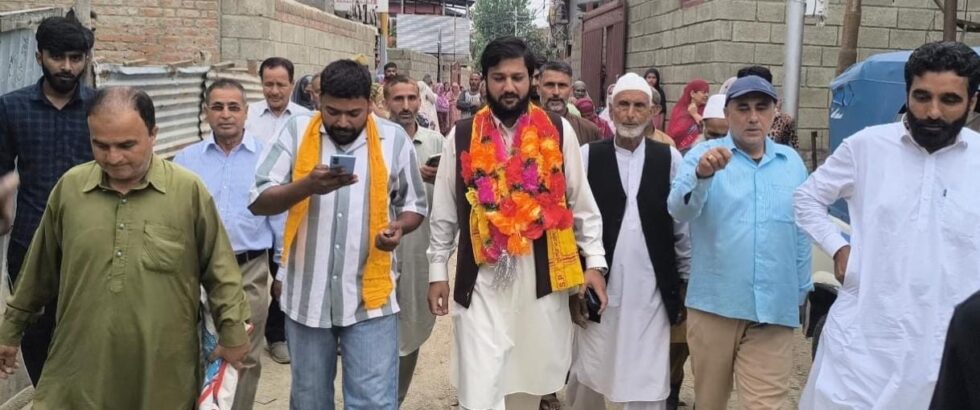
Jammu and Kashmir: The Suheldev Bharatiya Samaj Party has begun strengthening its organisational presence in Jammu and Kashmir under the leadership of its state president, Vivek Bali, as the party looks to broaden its grassroots network and participate more actively in discussions concerning the region’s political and social future.
Bali, who has previously been associated with the Bharatiya Janata Party and Janata Dal (United), joined the Suheldev Bharatiya Samaj Party in May 2025 in Lucknow in the presence of the party’s national president, Om Prakash Rajbhar.
Following his entry into the party, Bali was appointed to lead its Jammu and Kashmir unit. Since then, he has focused on organisational development, public outreach and issues affecting displaced communities, small traders and residents across the region.
Political journey across three parties
Bali began his political career with the Bharatiya Janata Party, where he held responsibilities within the Kashmir Displaced District unit. His roles reportedly included youth vice-president and district media secretary for Anantnag.
In 2021, he left the BJP and joined Janata Dal (United), initially serving as the party’s state secretary in Jammu and Kashmir. He was later elevated to the position of state general secretary.
His association with JD(U) ended in August 2024 after the party suspended him following a public controversy surrounding remarks attributed to him concerning the release of stone-pelters and political prisoners. The episode marked a significant turning point in his political career.
Bali subsequently joined the Suheldev Bharatiya Samaj Party in May 2025, beginning a new phase focused on building the party’s presence in Jammu and Kashmir.
Expanding SBSP’s presence in Jammu and Kashmir
Since assuming leadership of the party’s regional unit, Bali has held discussions with senior SBSP leaders regarding organisational expansion, electoral planning and the creation of a stronger grassroots structure.
The party’s efforts in Jammu and Kashmir come at a time when several national and regional political organisations are reassessing their strategies in the union territory. Questions surrounding the restoration of statehood, political representation, employment, rehabilitation and local development remain central to public debate.
Bali has argued that smaller political parties can contribute to this conversation by raising constituency-level concerns that may otherwise receive limited attention.
His meetings with the party leadership have focused on increasing membership, identifying district-level representatives and developing a structured organisation across Jammu and Kashmir.
However, the long-term influence of SBSP in the region will depend on its ability to create a sustained local network, attract credible leadership and convert public outreach into measurable political support.
Call for restoration of statehood
One of the principal issues raised by Bali has been the restoration of statehood to Jammu and Kashmir.
He has urged the central government to begin the process at the earliest possible stage, arguing that the restoration of full statehood would strengthen democratic representation and increase public confidence in political institutions.
The demand for statehood has also been raised by several political parties and civil society groups in the region. For SBSP’s Jammu and Kashmir unit, the issue is expected to remain an important part of its political agenda.
Bali has maintained that discussions concerning the future of Jammu and Kashmir should focus on democratic participation, regional unity, public welfare and equal opportunities for communities across both Jammu and Kashmir divisions.
Rehabilitation of displaced Kashmiri Pandits
As a member of the Kashmiri Pandit community, Bali has frequently spoken about the continuing challenges faced by displaced families.
He has supported what he describes as the safe and honourable rehabilitation of Kashmiri Pandits and has welcomed proposals intended to enhance monthly relief assistance for migrant families.
The displacement of Kashmiri Pandits remains one of the most sensitive and unresolved humanitarian and political issues connected with the region. Many families continue to live outside their original places of residence, while concerns relating to security, employment, housing and long-term rehabilitation remain unresolved.
Bali has said that any rehabilitation programme should address the practical concerns of displaced families rather than being limited to political announcements.
He has also called for greater attention to employment opportunities for younger members of the community, improved living conditions for migrant families and a rehabilitation framework developed through consultation with those directly affected.
Livelihood concerns of small vendors
Alongside broader political matters, Bali has also raised concerns affecting small traders and roadside vendors.
In December 2025, he appealed to the authorities to allow small vendors in Jammu to continue earning their livelihood. He argued that administrative action involving vendors should be balanced with the need to protect public spaces and maintain order.
Street vendors and small traders often support entire families through daily earnings and have limited financial protection when their business activities are interrupted.
Bali has advocated for a regulated approach under which vendors can operate in designated areas without creating difficulties for pedestrians, traffic or local businesses.
Such an approach, he has suggested, would allow the authorities to manage public spaces while protecting the livelihoods of economically vulnerable workers.
Public statements on humanitarian issues
Bali has also issued statements regarding humanitarian incidents and matters of public concern.
In January 2026, he expressed sorrow over a road accident in Doda that reportedly resulted in the deaths of ten soldiers. He called for compassionate support for the affected families and acknowledged the service and sacrifices of armed forces personnel operating in difficult conditions.
His political activities have additionally included statements regarding migrant relief, disaster assistance, employment, local infrastructure and the economic concerns of residents.
While such statements form part of routine political engagement, Bali’s larger challenge will be to translate public advocacy into structured policy proposals and sustained action through the party organisation.
Building a regional political organisation
SBSP is best known for its political activity in Uttar Pradesh, where it has developed a support base among several backward and marginalised communities.
Its expansion into Jammu and Kashmir represents an effort to establish a presence outside its traditional areas of influence.
For the party to become politically relevant in the region, it will need to develop positions that respond specifically to Jammu and Kashmir’s social, geographical and political conditions.
These include unemployment, tourism, agricultural development, rehabilitation of displaced communities, infrastructure, regional representation and the relationship between the union territory and the central government.
Under Bali’s leadership, the Jammu and Kashmir unit is expected to focus initially on organisational appointments, membership campaigns and engagement with community representatives.
The party may also seek to participate in future electoral activity, although the scale and nature of its involvement will depend on organisational readiness and decisions taken by the national leadership.
Focus on regional unity
Bali has publicly supported the territorial and social unity of Jammu and Kashmir.
He has argued that political discourse should avoid creating further divisions between regions or communities and should instead concentrate on development, democratic representation and public welfare.
The union territory contains diverse political expectations across Jammu, the Kashmir Valley and several displaced communities. Any political organisation seeking a meaningful role must therefore address concerns across regions rather than relying on a single-community approach.
Bali’s future political relevance will depend partly on whether he can expand his engagement beyond the Kashmiri Pandit community and build relationships with a wider cross-section of voters and civil society groups.
The road ahead
The coming period will be significant for both Bali and the Suheldev Bharatiya Samaj Party’s Jammu and Kashmir unit.
The party is still developing its structure in the region and faces competition from established national and regional organisations. Its ability to gain public attention will depend on consistent grassroots work, credible policy positions and participation in issues that directly affect residents.
Bali’s movement across the BJP, JD(U) and SBSP reflects a political career that has included organisational appointments, public controversy and changing party affiliations.
As state president of SBSP’s Jammu and Kashmir unit, he now faces the task of building a functioning political organisation while demonstrating how the party intends to contribute to the region’s political landscape.
Whether the party develops into a significant regional participant will depend not only on public statements but also on its ability to establish district-level leadership, undertake sustained public campaigns and present practical proposals on statehood, rehabilitation, employment and economic development.
For Bali, the next phase will therefore be measured by organisation, public impact and political participation rather than appointments alone.