



Aadil Nazir
SRINAGAR, JULY 24 : In a swift and courageous operation, Indian Army personnel rescued over a dozen elderly villagers stranded on the Tekpathri Ridge in Mukampuiran (Mouhra) after a cloudburst over the Ghoretal Nallah triggered sudden flash floods on Thursday evening, official sources said.
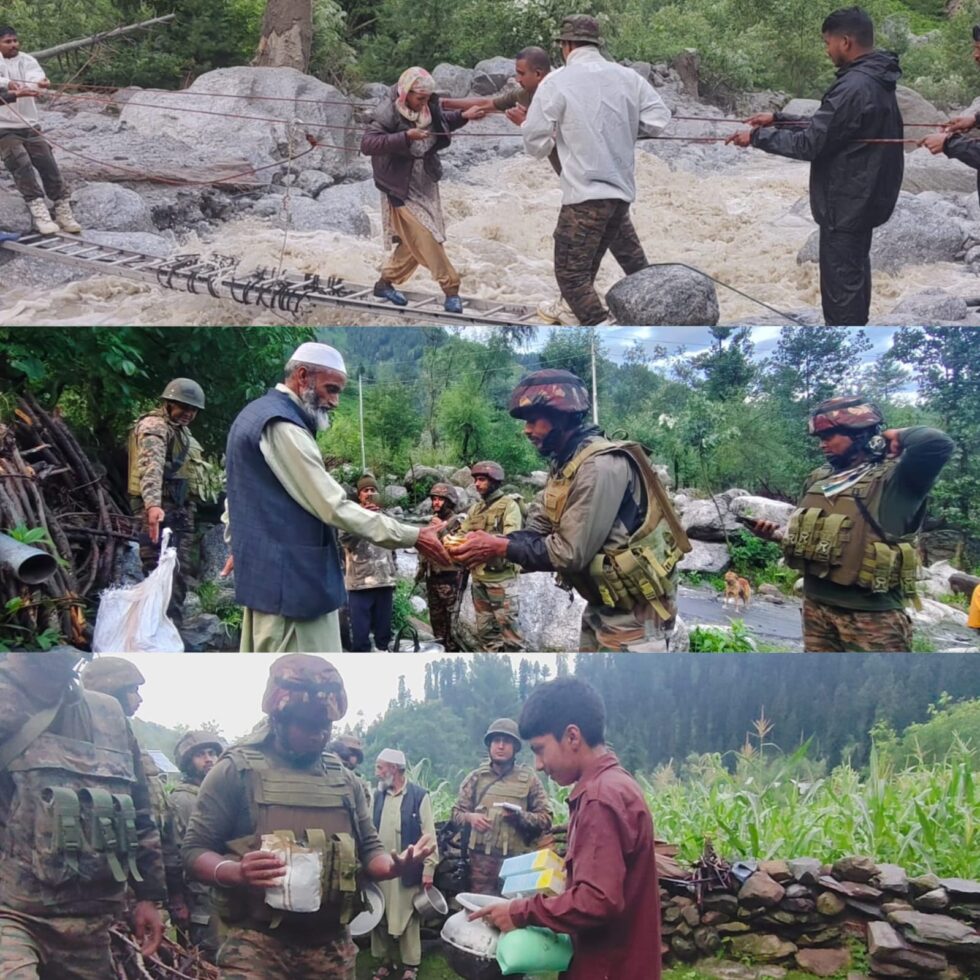
Army troops, responding to emergency distress calls from local authorities, reached the spot around 8 pm to find the only escape route submerged and the water level rising rapidly. In a three-hour-long operation, the soldiers waded through waist-deep turbulent waters, carrying the stranded villagers—including a 65-year-old man with a prosthetic leg—on their shoulders. All residents were safely evacuated and no casualties were reported, the sources added.
The rescue of the elderly man with the prosthetic leg proved to be the most challenging, officials said. Two soldiers carried him carefully while a third held his wife, refusing to separate the couple. At one point, the man slipped but the soldier holding him did not let go. “Uncle, I have you. Don’t look at the water. Look at me,” the soldier was heard telling him, according to eyewitnesses.
One elderly woman, unable to walk, was carried from the ridge straight to a waiting vehicle. She clutched the soldier’s collar throughout and refused to let go even after being seated. When she asked his name, the soldier reportedly smiled and said, “Beta, I am your son. That’s all you need to know.”
Despite being exhausted, soaked and bleeding from gripping wet ropes, the soldiers immediately distributed food, hot tea and blankets to the shivering survivors, sources said.
Local residents, who gathered on the safer side, watched the rescue unfold in stunned silence. When the last villager emerged, the crowd broke into applause, with some even falling to their knees, eyewitnesses said.
“These are not just soldiers. They are angels. The government machinery takes time. The Army doesn’t. They don’t wait for orders or permission. They just act. And because of them, not a single life was lost,” a local shopkeeper who helped coordinate the effort said.
The rescued villagers have been shifted to a temporary relief camp at a nearby school, where medical and counselling teams have been deployed. Most are still in shock but are safe, officials said.
The elderly man with the prosthetic leg, now resting at the camp, said: “I have lived 65 years. I have seen wars on television, poverty, loss, pain. But I have never seen anything like this. These boys walked into death for us—for strangers. All I have is my gratitude and my prayers.”
A senior Army officer, speaking on condition of anonymity, said: “When we joined the forces, we took an oath—not just to protect the nation from enemies, but to protect every citizen, no matter what. A flood, fire or war—it doesn’t matter. If a life is at stake, we will be there.”
On Friday evening, as the Army jeep drove away, villagers gathered near the crossing with folded hands and teary eyes, bowing in silent gratitude.
In a country often divided by politics, religion and language, the sight of a soldier carrying an old woman through raging waters is a powerful reminder of what unites us—humanity, sacrifice and the quiet courage of those who wear the uniform.